Bot or Not
- Period
- 2026
- Contribution
- Classifier comparison and evaluation tooling for the McGill challenge
- Status
- Public source and saved competition run

Comparing English and French bot classifiers, with reproducible selection reports and explicit evaluation boundaries.
For the McGill Bot or Not challenge, I worked on a language-specific classifier comparison and reporting pipeline. It combines account behavior, profile features, and text representations to classify accounts. English and French use separate models and thresholds; the bilingual wrapper coordinates their runs rather than training one multilingual model.
Comparing models before selecting a threshold
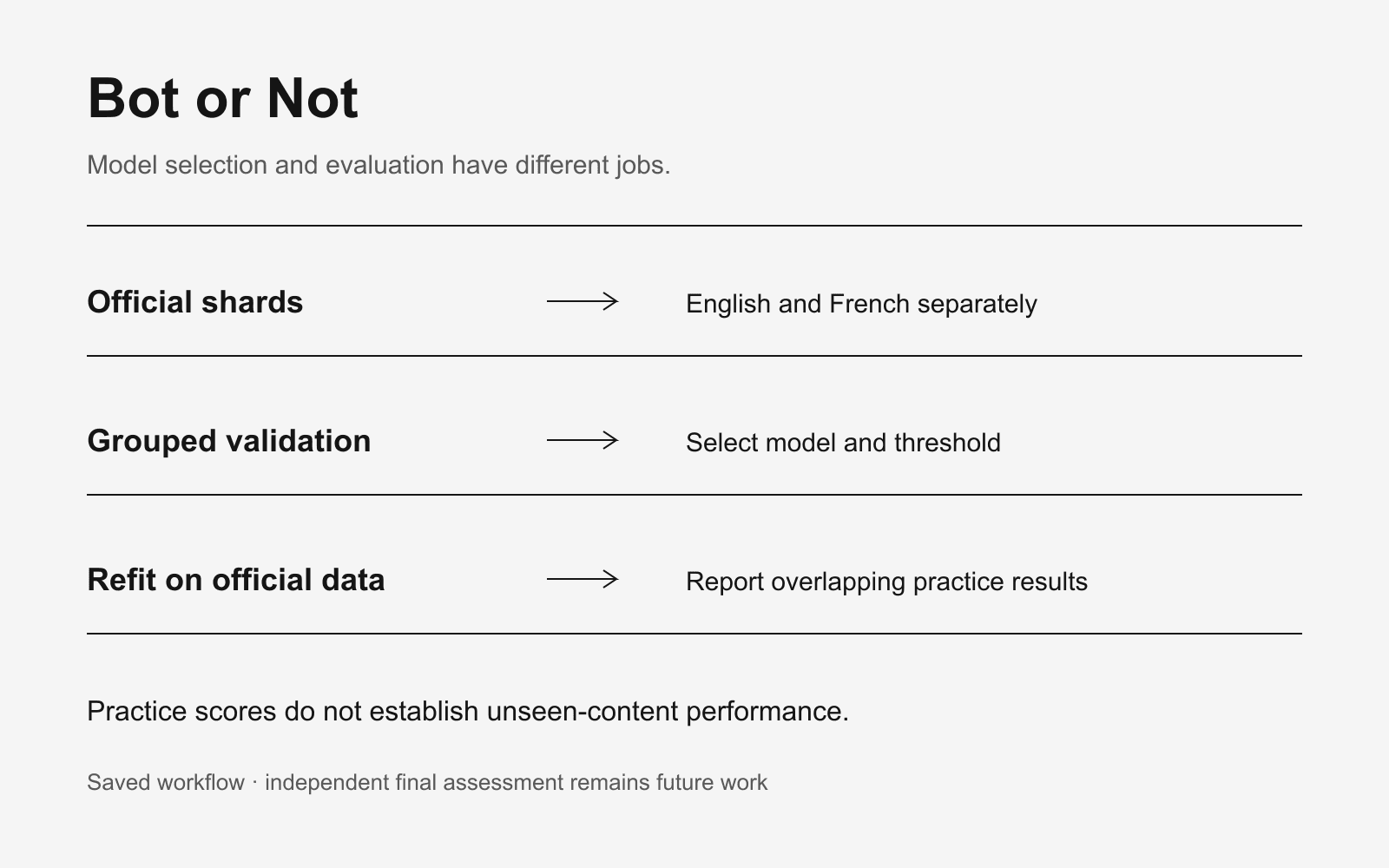
The pipeline compares logistic regression, a hybrid text model, histogram gradient boosting, ExtraTrees, and an ensemble. The official-first workflow groups validation by whole official dataset shards. Out-of-fold predictions select the model and language-specific threshold, after which the estimator is refit on the combined official training data. The run saves its configuration, selection report, model bundle, and prediction artifacts.
This path differs from the lower-level training command, which can reserve a
stratified primary holdout. The saved official-first run has no additional primary
holdout (selected_holdout is null). The
modeling tests
check that reserved holdout accounts stay out of selection-time fitting and that
predefined official fold IDs are respected. Those tests protect split behavior;
the default mocked suite does not reproduce expensive numerical training results.
What the saved practice scores mean
The run 20260404T162558Z-both-official-first-optimize reports:
- English practice shard 30: F1 0.95238 across 275 accounts, with TP 60, FP 0, FN 6, and TN 209.
- French practice shard 31: F1 1.000 across 171 accounts, with TP 27, FP 0, FN 0, and TN 144.
These are saved practice results, not an independent unseen-content evaluation. An October 2026 audit of the checked-in inputs found exact complete-text-timeline matches for 252 of 275 English practice accounts against official shards 1, 3, and 5, and for 164 of 171 French practice accounts against official shard 2 alone. English profiles differed: those 252 matches were not identical full records. For French, 131 of 171 matched the full profile and timestamped-post payload after excluding IDs. Account-ID disjointness alone does not catch renamed accounts with reused content.
The audit matched SHA-256 fingerprints of sorted complete post-text lists, and
separately of canonical profile/post payloads with identifier fields excluded.
It applies to inputs at revision 5539649f4757570eab0c1bdc8d304597492d7aa4.
The historical reports name the same dataset IDs but do not establish input-byte
parity through saved checksums. The training run and numerical scores were not
reproduced by that audit. The overlap limits the generalization claim; it does not
reconstruct every detail of the historical run or establish failure of the grouped
official validation.
The next evaluation boundary
The useful engineering result is a repeatable model-comparison, selection, and prediction workflow. The follow-up split audit records input and label checksums, multiset account-ID and content overlap, and label conflicts without publishing account records. Exact aliases stay together in outer holdout and out-of-fold splits. Incompatible fixed-shard or train/practice boundaries fail before fitting rather than silently moving records. The overlapping official/practice pairing therefore cannot pass the current optimization guard unchanged.
These exact-match checks do not detect paraphrases or establish independence for near duplicates. Internal estimator calibration is not group-aware and is not presented as an additional independent assessment. A stronger generalization result still requires a frozen protocol, independently labelled or appropriately grouped assessment data, and evaluation after model and threshold choices are fixed. That assessment remains future work. The historical practice artifacts retain their original labels and should be read with the overlap context above.